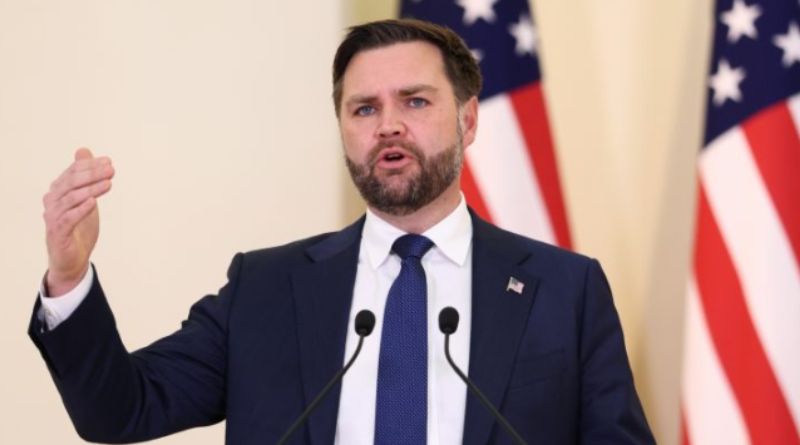

Vice President JD Vance sharply criticized a recent U.S. Supreme Court decision that found President Donald Trump exceeded his authority in imposing sweeping global tariffs, calling the ruling “lawlessness” in a social media post on Friday.
The Supreme Court, in a 6-3 decision, struck down the tariffs on Friday, ruling that Trump lacked the statutory authority under the International Emergency Economic Powers Act to implement broad trade penalties without explicit congressional authorization. The case has drawn significant attention as a legal rebuke of a key element of the administration’s trade policy.
In a post on X, Vance said the court’s interpretation “decided that Congress, despite giving the president the ability to ‘regulate imports,’ didn’t actually mean it,” and described the ruling as “lawlessness from the Court, plain and simple.”
“And its only effect will be to make it harder for the president to protect American industries and supply chain resiliency.”
He added, “President Trump has a wide range of other tariff powers, and he will use them to defend American workers and advance this administration’s trade priorities.”
The Supreme Court’s ruling marked a setback for the administration’s signature tariff strategy, which had aimed to address trade imbalances and strengthen domestic production. Trump responded to the decision by criticizing the court and signaling plans to pursue alternative legal avenues for trade measures.
The tariffs had targeted goods from a broad range of U.S. trading partners and were central to the White House’s economic agenda. The ruling upheld the constitutional principle that significant tariff authority lies with Congress, according to the court’s majority opinion.
Trump defended tariffs as key to his economic agenda, citing market benchmarks he claimed were achieved sooner than critics expected, Newsmax reported.
“Our stock market has just recently broken 50,000 on the Dow and simultaneously, and even more amazingly, broken 7,000 on the S&P, two numbers that everybody thought upon our landslide election victory could not be attained,” Trump told reporters Friday. “Think of that.
“Nobody thought it was possible to do it within four years. And we did it in one year,” Trump added.
Trump stated that the ruling still provided his administration considerable latitude to increase tariffs using other authorities, referencing a line he credited to Justice Brett Kavanaugh’s dissent.
“Although I firmly disagree with the court’s holding today, the decision might not substantially constrain a president’s ability to order tariffs going forward,” Trump said, reading from the dissent. “And it doesn’t.”
George Washington University Law School professor and legal scholar Jonathan Turley agreed this isn’t over. The administration can still impose tariffs through other statutes.
“The administration has other tools in its toolbox. It can actually impose tariffs under other statutes,” Turley said, adding that there’s plenty of runway for the Trump White House in this area of economic policy.
Lawyers for the Trump administration have argued in lower courts that the IEEPA allows a president to act in response to “unusual and extraordinary threats” and in cases where a national emergency has been declared.
Trump says that deep and “sustained” trade deficits are a national emergency that is bad enough to let him use his emergency powers.
The DOJ asked the Supreme Court to keep the tariffs in place, saying that not giving Trump the power to set tariffs under IEEPA “would leave our country open to trade retaliation without effective defenses.”
Plaintiffs said that no president has ever used the law to impose tariffs in the 50 years since it was passed. They also said that the trade deficit Trump talked about has been going on for almost 50 years, which they said goes against his claim that there is an “unusual and extraordinary” trade emergency.